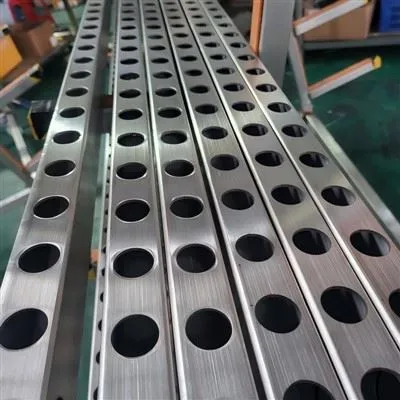
As a seasoned supplier of threaded stainless steel tubes, I often encounter inquiries from clients about the flow rate capacity of these essential components. The flow rate capacity of a threaded stainless steel tube is a critical factor in various industries, including plumbing, chemical processing, oil and gas, and food and beverage. Understanding this concept is vital for ensuring the efficient and safe operation of fluid systems. Threaded Stainless Steel Tube
Understanding Flow Rate Capacity
The flow rate capacity refers to the volume of fluid that can pass through a tube within a specific period. It is typically measured in units such as gallons per minute (GPM) or cubic meters per hour (m³/h). Several factors influence the flow rate capacity of a threaded stainless steel tube, including the tube’s diameter, wall thickness, length, the fluid’s viscosity, and the pressure differential across the tube.
Key Factors Influencing Flow Rate
Tube Diameter
The diameter of the tube is one of the most significant factors affecting the flow rate. A larger diameter tube generally allows for a higher flow rate because it provides a greater cross – sectional area for the fluid to pass through. According to the Hagen – Poiseuille’s law for laminar flow in a cylindrical tube, the volumetric flow rate (Q) is proportional to the fourth power of the radius (r) of the tube. Mathematically, (Q=\frac{\pi r^{4}\Delta P}{8\mu L}), where (\Delta P) is the pressure difference across the tube, (\mu) is the dynamic viscosity of the fluid, and (L) is the length of the tube. This shows that even a small increase in the diameter can lead to a significant increase in the flow rate.
Wall Thickness
The wall thickness of the threaded stainless steel tube also plays a role. While it may seem that wall thickness has a minimal direct impact on flow rate, it can affect the internal diameter of the tube. A thicker – walled tube will have a smaller internal diameter, which, as mentioned earlier, can reduce the flow rate. Additionally, wall thickness can influence the tube’s ability to withstand pressure, which is crucial in high – flow applications where pressure differentials are significant.
Tube Length
The length of the tube is inversely proportional to the flow rate. As the length of the tube increases, the resistance to fluid flow also increases. This is because the fluid has to travel a longer distance, encountering more friction along the inner surface of the tube. In practical applications, longer tubes may require higher pressure differentials to maintain a desired flow rate.
Fluid Viscosity
Viscosity is a measure of a fluid’s resistance to flow. Fluids with high viscosity, such as honey or heavy oils, flow more slowly than low – viscosity fluids like water or gasoline. In a threaded stainless steel tube, high – viscosity fluids will have a lower flow rate compared to low – viscosity fluids under the same pressure and tube conditions. The viscosity of the fluid affects the frictional forces within the tube, which in turn affect the flow rate.
Pressure Differential
The pressure differential across the tube is the driving force for fluid flow. A higher pressure at the inlet of the tube compared to the outlet creates a force that pushes the fluid through the tube. According to Bernoulli’s principle and the laws of fluid dynamics, increasing the pressure differential can increase the flow rate. However, the tube must be able to withstand the pressure without deformation or failure.
Calculating Flow Rate Capacity
There are several methods to calculate the flow rate capacity of a threaded stainless steel tube. For laminar flow (where the fluid moves in smooth layers), the Hagen – Poiseuille’s law mentioned earlier can be used. However, in most industrial applications, the flow is turbulent rather than laminar. For turbulent flow, empirical equations and charts, such as the Darcy – Weisbach equation, are commonly used.
The Darcy – Weisbach equation is (h_f = f\frac{L}{D}\frac{V^{2}}{2g}), where (h_f) is the head loss due to friction, (f) is the Darcy friction factor, (L) is the length of the pipe, (D) is the diameter of the pipe, (V) is the average velocity of the fluid, and (g) is the acceleration due to gravity. The flow rate ((Q)) can then be calculated from the average velocity ((V)) using the formula (Q = A\times V), where (A) is the cross – sectional area of the tube.
Importance of Accurate Flow Rate Calculation
Accurately calculating the flow rate capacity of a threaded stainless steel tube is crucial for several reasons. In plumbing systems, an incorrect flow rate can lead to problems such as insufficient water supply, low water pressure, or noisy pipes. In chemical processing plants, improper flow rates can affect the efficiency of chemical reactions, product quality, and safety. In the oil and gas industry, incorrect flow rate calculations can lead to pipeline blockages, reduced production, and even accidents.
Applications and Flow Rate Requirements
Different industries have specific flow rate requirements for threaded stainless steel tubes.
Plumbing
In residential and commercial plumbing, the flow rate of water through threaded stainless steel tubes is a key consideration. For example, kitchen faucets typically require a flow rate of 2 – 3 GPM to provide a suitable amount of water for washing hands and dishes. Showerheads may have a flow rate of 1.5 – 2.5 GPM to ensure a comfortable shower experience. Larger pipes used for main water supply lines in a building need to have a higher flow rate capacity to meet the overall water demand.
Chemical Processing
In chemical processing, the flow rate of various chemicals through threaded stainless steel tubes must be carefully controlled. Some chemical reactions require precise flow rates to ensure the correct stoichiometry and product quality. For example, in a chemical reactor, the feedstock chemicals need to be introduced at a specific flow rate to maintain the reaction rate and prevent over – or under – production.
Oil and Gas
The oil and gas industry places high demands on the flow rate capacity of threaded stainless steel tubes. In pipelines, large – diameter tubes are used to transport crude oil and natural gas over long distances. The flow rate needs to be high enough to ensure efficient transportation but also regulated to prevent pipeline corrosion, erosion, and other issues. In offshore platforms, where space is limited, the design of the tubing systems must optimize flow rate capacity while considering the available equipment and safety factors.
Food and Beverage
In the food and beverage industry, threaded stainless steel tubes are used for transporting liquids such as milk, juice, and beer. The flow rate is important for maintaining the quality of the product and ensuring efficient production. For example, in a dairy processing plant, the milk needs to be transported at a specific flow rate through the pipes to prevent spoilage and maintain the proper temperature.
Quality and Flow Rate
The quality of the threaded stainless steel tube can also affect the flow rate capacity. High – quality tubes with smooth inner surfaces have less friction, which allows the fluid to flow more easily. A rough inner surface can cause turbulence and increase the resistance to flow, reducing the overall flow rate. Additionally, properly manufactured threads ensure a tight connection between tubes, preventing leaks that could disrupt the flow.
Our Role as a Supplier
As a threaded stainless steel tube supplier, we play a crucial role in helping our clients understand and meet their flow rate requirements. We offer a wide range of tube sizes and wall thicknesses to accommodate different applications. Our team of experts can assist clients in selecting the right tube based on their specific flow rate needs, considering factors such as fluid type, pressure, and temperature.
We also provide detailed technical support, including flow rate calculations and advice on installation. Our tubes are manufactured to the highest quality standards, ensuring smooth inner surfaces and accurate thread dimensions. This helps to optimize the flow rate capacity and the overall performance of the fluid systems in which our tubes are used.
Conclusion

The flow rate capacity of a threaded stainless steel tube is a complex but essential concept in many industries. Understanding the factors that influence flow rate, such as tube diameter, wall thickness, length, fluid viscosity, and pressure differential, is crucial for accurate design and operation of fluid systems. As a supplier, we are committed to providing high – quality tubes and expert support to help our clients achieve optimal flow rate performance.
Straight Stainless Steel Tube If you are interested in learning more about the flow rate capacity of our threaded stainless steel tubes or have a specific project in mind, we encourage you to contact us. Our team is ready to have in – depth discussions, provide customized solutions, and assist in your procurement process. Let’s work together to ensure the success of your fluid system applications.
References
- Cengel, Y. A., & Cimbala, J. M. (2014). Fluid Mechanics: Fundamentals and Applications. McGraw – Hill Education.
- Munson, B. R., Young, D. F., & Okiishi, T. H. (2012). Fundamentals of Fluid Mechanics. John Wiley & Sons.
- Darby, R. (2001). Chemical Engineering Fluid Mechanics. Marcel Dekker.
China Super Tech Co., Ltd.
As one of the most professional threaded stainless steel tube manufacturers and suppliers in China, we’re featured by quality products and good service. Please rest assured to wholesale OEM threaded stainless steel tube from our factory. Also, custom service is available.
Address: Wangjing Science and Technology Park, Guangshun North Street, Chaoyang District, Beijing
E-mail: sales@316liquidcooling.com
WebSite: https://www.316liquidcooling.com/
